Chris Squire: The Bass of Progressive Rock
A thundering bassline beckoned Chris Squire to music’s frontier. Born on March 4, 1948, in London, England, Squire grew up in a post-war suburb. His parents’ Elvis Presley records filled their home. Yet, it was The Beatles’ harmonic daring that gripped him. As a teen, he plucked bass strings in garages. Consequently, his music career was driven by a passion to push rock’s boundaries.
A Rocker’s Spark
Squire’s youth was steeped in melody. His father, a salesman, and mother, a homemaker, supported his talent. As a boy, he sang in church choirs, his voice clear. However, a 1964 The Who concert ignited his dream. The raw power inspired him. Thus, he pursued music to craft intricate, groundbreaking sounds.
From London to Prog Legend
Christopher Russell Edward Squire was born into a working-class family. His early years were shaped by 1960s London’s vibrancy. By 15, he taught himself bass, inspired by John Entwistle. After leaving school, he worked as a shop assistant, gigging at night. In 1967, he co-founded Yes, a progressive rock band, at 19. Their debut, Yes (1969), launched a genre-defining career.
Squire remained Yes’ backbone through multiple lineups, releasing 21 studio albums. He also pursued solo work, like Fish Out of Water (1975). Squire passed away on June 27, 2015, at 67, in Phoenix, Arizona, survived by his wife, Scotland, and five children. His legacy endures through prog rock’s evolution.
Career Symphony: Bands and Collaborations
Squire’s career is synonymous with Yes (1967–2015), where he played bass and sang backing vocals. The classic lineup included Jon Anderson (vocals), Steve Howe (guitar), Rick Wakeman (keyboards), and Bill Bruford (drums). He briefly led The Syn (1965–1967) and XYZ (1981) with Jimmy Page. Additionally, his Chris Squire Experiment explored solo ideas in the 1990s.
Collaborations enriched his sound. He worked with Robert Plant on Led Zeppelin’s “The Song Remains the Same” sessions. His duet with Billy Sherwood, “Conspiracy” (2000), blended prog and pop. Meanwhile, his friendship with Peter Banks, Yes’ first guitarist, often made headlines, despite early tensions. Squire’s rumored rift with Rick Wakeman over band direction sparked gossip, but they reconciled.
Media appearances boosted his profile. Squire performed on Top of the Pops and The Old Grey Whistle Test with Yes. He appeared in the documentary Yessongs (1975). His music featured in Buffy the Vampire Slayer (1997). Moreover, he guested on VH1’s That Metal Show, sharing prog tales. His Rock and Roll Hall of Fame induction with Yes (2017) honored his legacy posthumously.
Awards were modest but significant. Yes won a Grammy nomination for Best Rock Performance (“Owner of a Lonely Heart,” 1984). Squire earned a Prog God Award from Prog Magazine (2013). Additionally, he received a Bass Player Magazine Lifetime Achievement Award (2012). His innovative basslines inspired countless musicians.
Here are some of Yes’ biggest songs featuring Squire, with their writers:
- Owner of a Lonely Heart (Writers: Jon Anderson, Trevor Rabin, Chris Squire, Trevor Horn)
- Roundabout (Writers: Jon Anderson, Steve Howe)
- Close to the Edge (Writers: Jon Anderson, Steve Howe)
- Starship Trooper (Writers: Jon Anderson, Chris Squire, Steve Howe)
Controversies and Public Echoes
Squire’s career faced turbulence. In 1980, he and Jon Anderson clashed over Yes’ direction, leading to a band hiatus. Fans picked sides; Squire stayed firm. Additionally, a 2008 vocal cord surgery sparked health concerns. He recovered, but tour cancellations frustrated fans. Meanwhile, his 2015 leukemia diagnosis and death shocked the music world. Tributes poured in, highlighting his impact.
In 2010, a legal dispute over Yes’ name made headlines. Squire sued former members, claiming ownership. The case settled quietly. Moreover, his conservative views on music piracy stirred debate. He criticized illegal downloads, clashing with tech-savvy fans. Nevertheless, his dedication to prog rock kept him revered.
A Stage to Remember: Madison Square Garden 1977
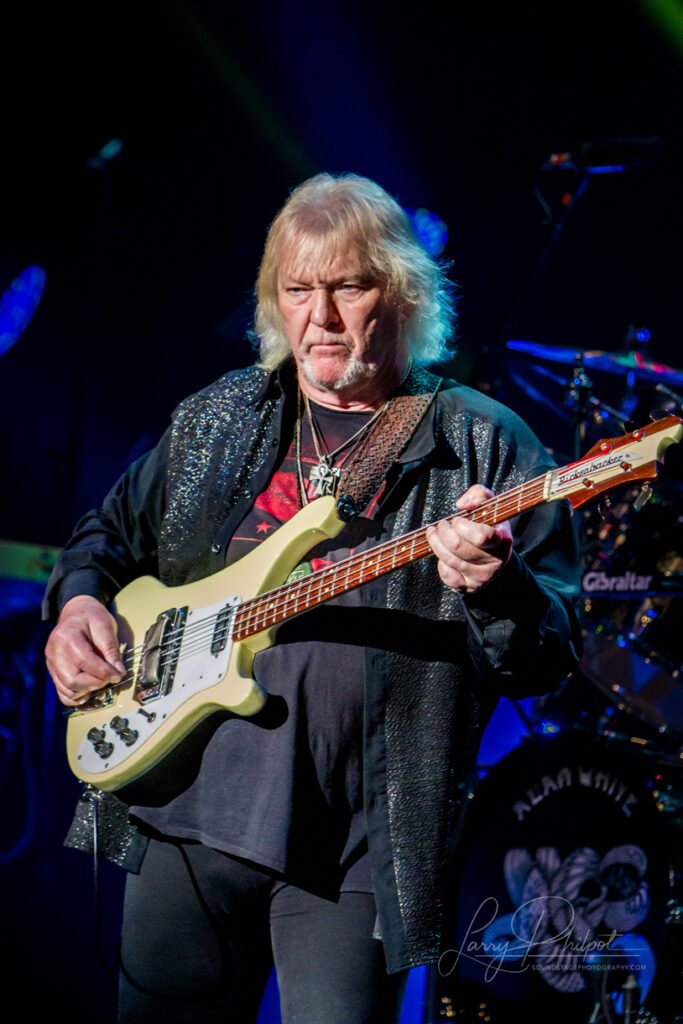
In August 1977, Squire played with Yes at Madison Square Garden, a prog rock pinnacle. The arena pulsed with 20,000 fans. As he strode onstage, his Rickenbacker bass gleaming, he launched into “Close to the Edge.” His fingers danced, driving the epic. Midway through, he and Rick Wakeman traded solos on “Roundabout,” the crowd erupting. Fans swayed, lost in the sound. Squire later called it “a night where music soared.” The performance, captured in Yesshows (1980), became a prog touchstone, showcasing Squire’s commanding presence.
Legacy and Eternal Notes
Squire’s influence lives on. His basslines inspire bands like Dream Theater. In 2025, Yes tours with Billy Sherwood honoring Squire’s parts. Meanwhile, a documentary, The Fish Lives, is in production, celebrating his life. His impact on players like Geddy Lee is undeniable, redefining bass in rock. For Squire, music was exploration. As he played “Owner of a Lonely Heart,” it was about pushing sound to new frontiers.